-
18
Highly ordered clustering of TNFα and BAFF ligand-receptor-intracellular adaptor complexes on a lipid membrane
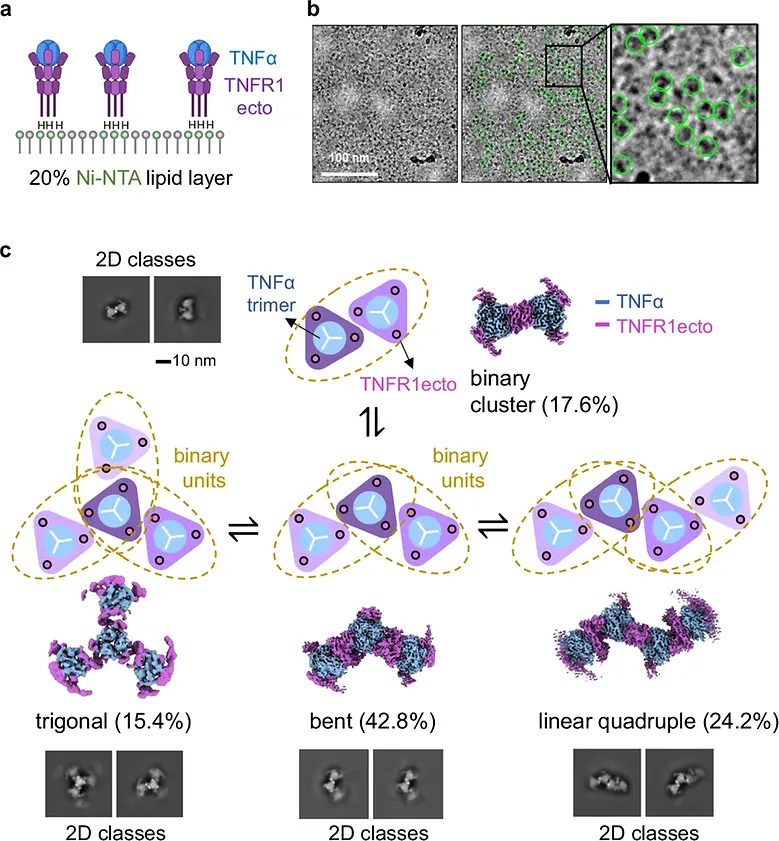
The TNF family plays a critical role in immune regulation. Here, we present high-resolution structures of clusters formed by two TNF receptor family proteins, TNFR1 and BAFFR. Using a lipid monolayer method to mimic their membrane-bound state, we observe that the TNFα-TNFR1 complex forms highly ordered clusters of trimers on the lipid membrane. A non-competitive TNFR1 antagonist that inhibits receptor activation disrupted these clusters without blocking ligand binding or receptor trimerization. Furthermore, we find that the BAFF-BAFFR, BAFF-TACI, and BAFF-BCMA receptor-ligand complexes predominantly form pentagonal clusters of trimers on the lipid membrane. Notably, the binding of the intracellular adaptor TRAF3 to the BAFF-BAFFR complex induces a structural transition from a pentagonal to a flat hexagonal cluster. Mutations in BAFF that impair BAFFR activation prevented cluster formation. Our findings demonstrate that ligand binding induces the formation of highly ordered clusters of TNFR1 and BAFFR receptors on the lipid membrane, which is essential for their activation.
-
17
IL9 Polarizes Macrophages to M1 and Induces the Infiltration of Antitumor Immune Cells via MIP-1 and CXCR3 Chemokines
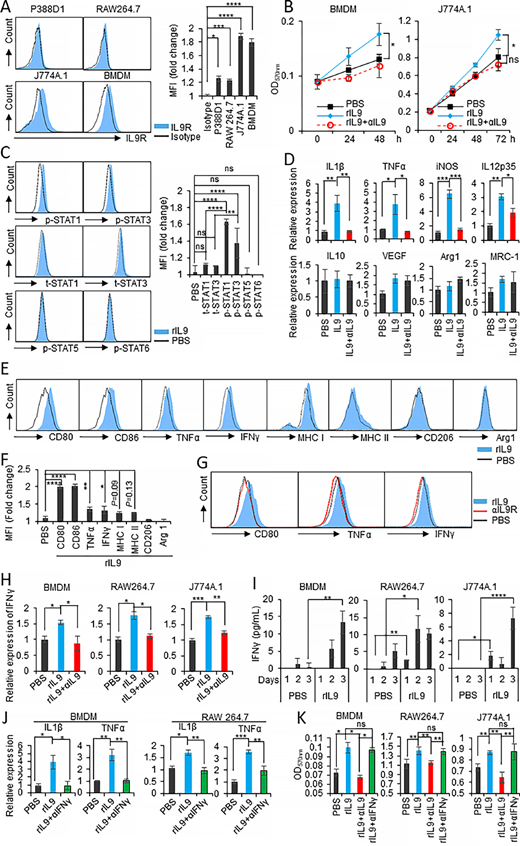
Tumor-associated macrophages (TAM) are involved in tumor progression, metastasis, and immunosuppression. Because TAMs are highly plastic and could alter their phenotypes to proinflammatory M1 in response to environmental stimuli, reeducating TAMs has emerged as a promising approach to overcoming the challenges of solid cancer treatment. This study investigated the effect of IL9 on macrophage M1 polarization and verified its antitumor potential to retrain TAMs and promote chemokine secretion. We demonstrated that IL9 stimulated macrophage proliferation and polarized them toward the proinflammatory M1 phenotype in an IFNγ-dependent manner. Tumor-localized IL9 also polarized TAMs toward M1 in vivo and made them release CCL3/4 and CXCL9/10 to recruit antitumor immune cells, including T and natural killer cells, into the tumor microenvironment. Furthermore, peritoneal treatment with recombinant IL9 delayed the growth of macrophage-enriched B16F10 melanoma and 4T1 breast cancer in syngeneic mice, although IL9 treatment did not reduce tumor growth in the absence of macrophage enrichment. These results demonstrate the efficacy of IL9 in macrophage polarization to trigger antitumor immunity.
-
16
TLR3 forms a highly organized cluster when bound to a poly(I:C) RNA ligand
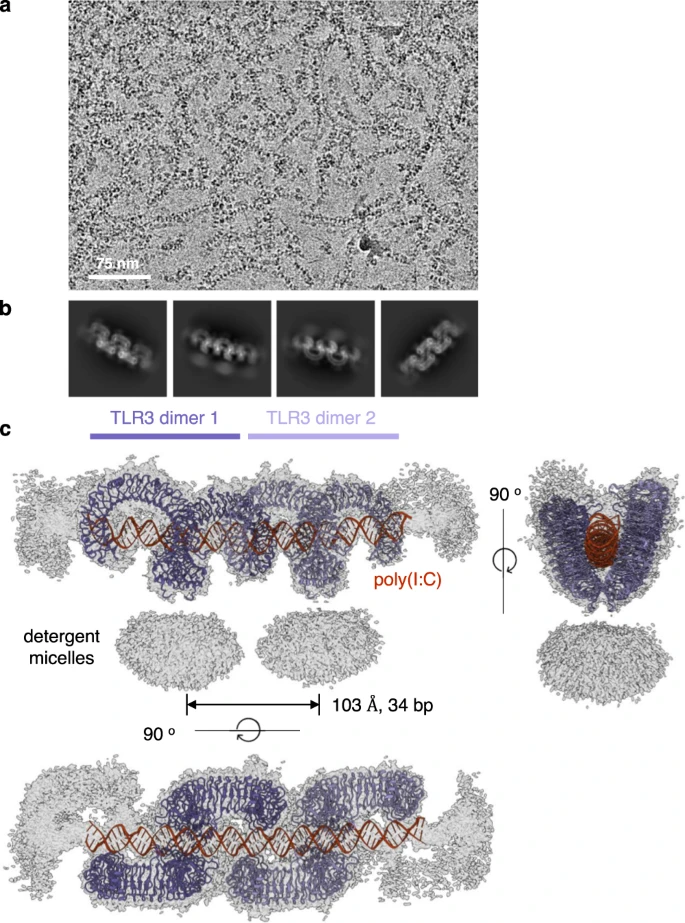
Toll-like Receptor 3 (TLR3) initiates a potent anti-viral immune response by binding to double-stranded RNA ligands. Previous crystallographic studies showed that TLR3 forms a homodimer when bound to a 46-base pair RNA ligand. However, this short RNA fails to initiate a robust immune response. To obtain structural insights into the length dependency of TLR3 ligands, we determine the cryo-electron microscopy structure of full-length TLR3 in a complex with a synthetic RNA ligand with an average length of ~400 base pairs. In the structure, the dimeric TLR3 units are clustered along the double-stranded RNA helix in a highly organized and cooperative fashion with a uniform inter-dimer spacing of 103 angstroms. The intracellular and transmembrane domains are dispensable for the clustering because their deletion does not interfere with the cluster formation. Our structural observation suggests that ligand-induced clustering of TLR3 dimers triggers the ordered assembly of intracellular signaling adaptors and initiates a robust innate immune response.
-
15
Protective and Therapeutic Effects of an IL-15:IL-15Rα-Secreting Cell-Based Cancer Vaccine Using a Baculovirus System
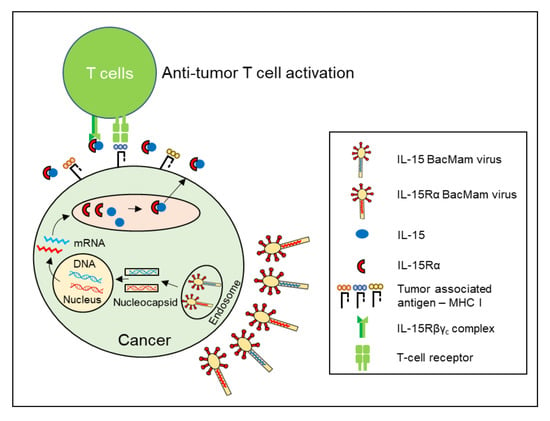
first_pagesettingsOrder Article Reprints Open AccessArticle Protective and Therapeutic Effects of an IL-15:IL-15Rα-Secreting Cell-Based Cancer Vaccine Using a Baculovirus System by Van Anh Do-Thi 1,†,Hayyoung Lee 2,†,Hye Jin Jeong 1,Jie-Oh Lee 1,* andYoung Sang Kim 3,* 1 Department of Life Sciences, Pohang University of Science and Technology, Pohang 37673, Korea 2 Institute of Biotechnology, Chungnam National University, Daejeon 34134, Korea 3 Department of Biochemistry, College of Natural Sciences, Chungnam National University, Daejeon 34134, Korea * Authors to whom correspondence should be addressed. † These authors contributed equally to this work. Cancers 2021, 13(16), 4039; https://doi.org/10.3390/cancers13164039 Submission received: 18 June 2021 / Revised: 22 July 2021 / Accepted: 4 August 2021 / Published: 11 August 2021 (This article belongs to the Topic Animal Model in Biomedical Research) Downloadkeyboard_arrow_down Browse Figures Versions Notes Simple Summary Interleukin (IL) 15 is a proinflammatory cytokine and is well-known as an efficacious cytokine for cancer immunotherapy. Interestingly, the IL-15:IL-15Rα complex, a self-assembling form of IL-15 and its soluble receptor α (IL-15Rα), has shown greater antitumor activity than IL-15 itself. However, the development of a suitable multigene delivery system is needed for further applications of IL-15:IL-15Rα. Baculovirus, an arthropod-specific virus, is known for its adjuvant effect in cancer therapy. Here, we investigated the potential of the BacMam virus, a modified baculovirus for gene delivery into mammalian cells, as a novel multigene delivery system to generate a cell-based cancer vaccine secreting the self-assembling IL-15:IL-15Rα complex. Vaccination with a BacMam-based IL-15:IL-15Rα cancer vaccine triggered antitumor immune responses in a tumor antigen-specific manner. Our findings indicate that the BacMam system is a safe and effective method to produce protective and therapeutic cancer vaccines. Abstract This study reports the use of the BacMam system to deliver and express self-assembling IL-15 and IL-15Rα genes to murine B16F10 melanoma and CT26 colon cancer cells. BacMam-based IL-15 and IL-15Rα were well-expressed and assembled to form the biologically functional IL-15:IL-15Rα complex. Immunization with this IL-15:IL-15Rα cancer vaccine delayed tumor growth in mice by inducing effector memory CD4+ and CD8+ cells and effector NK cells which are tumor-infiltrating. It caused strong antitumor immune responses of CD8+ effector cells in a tumor-antigen specific manner both in vitro and in vivo and significantly attenuated Treg cells which a control virus-infected cancer vaccine could induce. Post-treatment with this cancer vaccine after a live cancer cell injection also prominently delayed the growth of the tumor. Collectively, we demonstrate a vaccine platform consisting of BacMam virus-infected B16F10 or CT26 cancer cells that secrete IL-15:IL-15Rα. This study is the first demonstration of a functionally competent soluble IL-15:IL-15Rα complex-related cancer vaccine using a baculovirus system and advocates that the BacMam system can be used as a secure and rapid method of producing a protective and therapeutic cancer vaccine.
-
14
Application of antihelix antibodies in protein structure determination
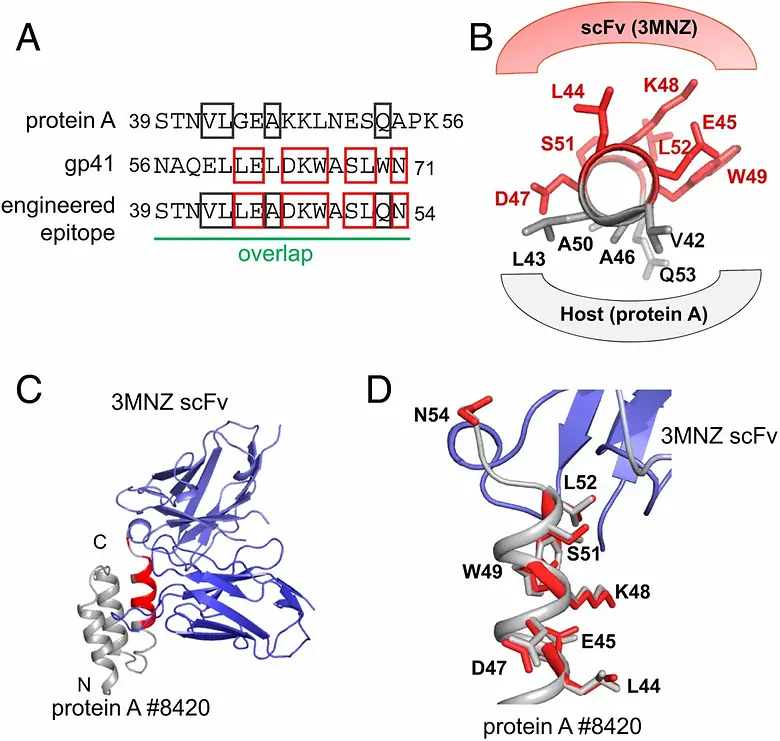
Antibodies are indispensable tools in protein engineering and structural biology. Antibodies suitable for structural studies should recognize the 3-dimensional (3D) conformations of target proteins. Generating such antibodies and characterizing their complexes with antigens take a significant amount of time and effort. Here, we show that we can expand the application of well-characterized antibodies by “transplanting” the epitopes that they recognize to proteins with completely different structures and sequences. Previously, several antibodies have been shown to recognize the alpha-helical conformation of antigenic peptides. We demonstrate that these antibodies can be made to bind to a variety of unrelated “off-target” proteins by modifying amino acids in the preexisting alpha helices of such proteins. Using X-ray crystallography, we determined the structures of the engineered protein–antibody complexes. All of the antibodies bound to the epitope-transplanted proteins, forming accurately predictable structures. Furthermore, we showed that binding of these antihelix antibodies to the engineered target proteins can modulate their catalytic activities by trapping them in selected functional states. Our method is simple and efficient, and it will have applications in protein X-ray crystallography, electron microscopy, and nanotechnology.
-
13
Higd-1a regulates the proliferation of pancreatic cancer cells through a pERK/p27KIP1/pRB pathway
Higd-1a/HIMP1-a/HIG1, a mitochondrial inner membrane protein, promotes cell survival under low glucose and hypoxic conditions. We previously reported that it interacts with Opa1, a factor involved in mitochondrial fusion, to regulate mitochondrial homeostasis. In the present study, we found that depletion of Higd-1a inhibited the proliferation of pancreatic cancer cells in vitro and in mice xenografts. Higd-1a knockdown did not itself lead to cell death but it caused cell cycle arrest through induction of p27KIP1 and hypo-phosphorylation of RB protein. Knockdown of Higd-1a also induced cellular senescence as shown by increased granularity and SA-β-galactosidase activity. We further showed that the mitochondrial stress induced by Higd-1a led to reduced ERK phosphorylation. Inhibition of the ERK pathway with U0126 induced p27KIP1 expression in the pancreatic cancer cells, confirming that the cell cycle retardation was the result of inhibition of the ERK pathway. Array analysis of human pancreatic cancers revealed that expression of Higd-1a was significantly elevated in pancreatic cancer tissues compared to normal tissue. Collectively, our results demonstrate that Higd-1a plays an important role in the proliferation of pancreatic cancer cells by regulating the pERK/p27KIP1/pRB signaling pathway.
-
12
Attachment of flagellin enhances the immunostimulatory activity of a hemagglutinin-ferritin nano-cage
Hemagglutinin (HA) displayed on a ferritin nano-cage has been shown to be effective in generating a potent immune response against a broad range of influenza infections. Here, we showed that conjugation of flagellin together with HA to the exterior surface of the ferritin cage greatly enhanced not only the humoral immune response in mice but also antigen-specific T cell responses that include Th1 cytokine secretion. The effect of flagellin remained essentially unchanged when the molar ratio of flagellin to HA was reduced from 1:1 to 1:3. Injection of the ferritin-HA-flagellin cage provided protection against lethal virus challenge in mice. We used a small immunoglobulin fragment VL12.3 as a convenient method for attaching HA and flagellin to the ferritin cage. This attachment method can be used for rapid screening of a variety of protein cages and nano-assemblies to identify the most suitable carrier and adjuvant proteins for the target antigen.
-
11
Structural diversity and flexibility of diabodies
Diabodies are bispecific antibody fragments that have two antigen binding Fv domains. They are unique among hundreds of different formats of bispecific antibodies because they are small and rigid enough to be crystallized. Diabodies are generated by connecting variable regions of heavy and light chains by a peptide linker. Because of the short length of the linker, intramolecular association of the variable regions is not allowed. Instead, the variable regions from the different peptide chains associate together, forming a dimeric complex with two antigen binding sites. Previous crystallographic studies of diabodies demonstrate the extraordinary structural diversity of diabodies. They have also shown that the relative orientation and interaction of the two Fv domains in diabodies have substantial flexibility due to instability of the Fv interface. Introduction of site specific mutations and disulfide bridges can reduce flexibility and therefore increase rigidity and predictability of the diabody structures. These stabilized diabodies will be useful for future application to structural biology and protein nanotechnology.
-
10
The application of helix fusion methods in structural biology
Methods generating fusion proteins with rigid and predictable structures have been developed in recent years. Among them, helix fusion methods that link two proteins by connecting their terminal alpha helices into a single and extended alpha helix can be particularly useful because designing fusion helices is conceptually and technically simple. These methods have been shown crucial in obtaining crystals that diffract x-rays to high resolution or attaching large and symmetrical backbone proteins to small target proteins for cryo-EM analysis. The structural rigidity of the fusion helix is crucial for these applications, and the reduction of structural ambiguity and flexibility at the fusion sites will further enhance the usefulness of this method.
-
9
Structural Insights into Modulation of Neurexin-Neuroligin Trans-synaptic Adhesion by MDGA1/Neuroligin-2 Complex.
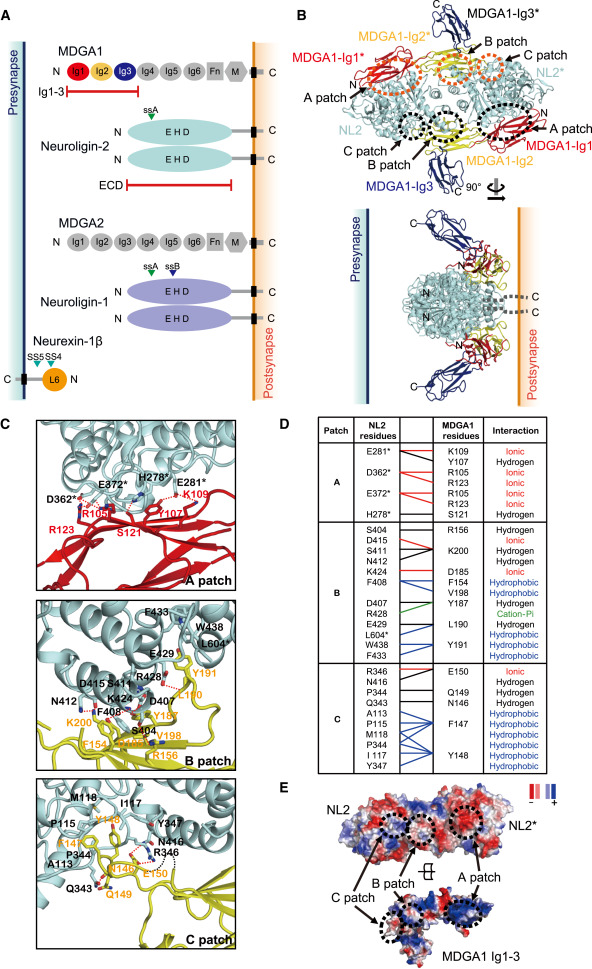
Membrane-associated mucin domain-containing glycosylphosphatidylinositol anchor proteins (MDGAs) bind directly to neuroligin-1 (NL1) and neuroligin-2 (NL2), thereby respectively regulating excitatory and inhibitory synapse development. However, the mechanisms by which MDGAs modulate NL activity to specify development of the two synapse types remain unclear. Here, we determined the crystal structures of human NL2/MDGA1 Ig1-3 complex, revealing their stable 2:2 arrangement with three interaction interfaces. Cell-based assays using structure-guided, site-directed MDGA1 mutants showed that all three contact patches were required for the MDGA's negative regulation of NL2-mediated synaptogenic activity. Furthermore, MDGA1 competed with neurexins for NL2 via its Ig1 domain. The binding affinities of both MDGA1 and MDGA2 for NL1 and NL2 were similar, consistent with the structural prediction of similar binding interfaces. However, MDGA1 selectively associated with NL2, but not NL1, in vivo. These findings collectively provide structural insights into the mechanism by which MDGAs negatively modulate synapse development governed by NLs/neurexins.
 13Higd-1a regulates the proliferation of pancreatic cancer cells through a pERK/p27KIP1/pRB pathwayHigd-1a/HIMP1-a/HIG1, a mitochondrial inner membrane protein, promotes cell survival under low glucose and hypoxic conditions. We previously reported that it interacts with Opa1, a factor involved in mitochondrial fusion, to regulate mitochondrial homeostasis. In the present study, we found that depletion of Higd-1a inhibited the proliferation of pancreatic cancer cells in vitro and in mice xenografts. Higd-1a knockdown did not itself lead to cell death but it caused cell cycle arrest through induction of p27KIP1 and hypo-phosphorylation of RB protein. Knockdown of Higd-1a also induced cellular senescence as shown by increased granularity and SA-β-galactosidase activity. We further showed that the mitochondrial stress induced by Higd-1a led to reduced ERK phosphorylation. Inhibition of the ERK pathway with U0126 induced p27KIP1 expression in the pancreatic cancer cells, confirming that the cell cycle retardation was the result of inhibition of the ERK pathway. Array analysis of human pancreatic cancers revealed that expression of Higd-1a was significantly elevated in pancreatic cancer tissues compared to normal tissue. Collectively, our results demonstrate that Higd-1a plays an important role in the proliferation of pancreatic cancer cells by regulating the pERK/p27KIP1/pRB signaling pathway.